
Book review: Frontières en mouvement (Frontem): Which Models of Cross-Border Cooperation for the EU?
| 2024. October 08.
Information
- Title: Frontières en mouvement (Frontem). Which Models of Cross-Border Cooperation for the EU?
- Editor: Birte Wassenberg
- Publisher: Peter Lang
- Year of publication: 2024
- Language: English
- Pages: 644
- DOI: 3726/b21864
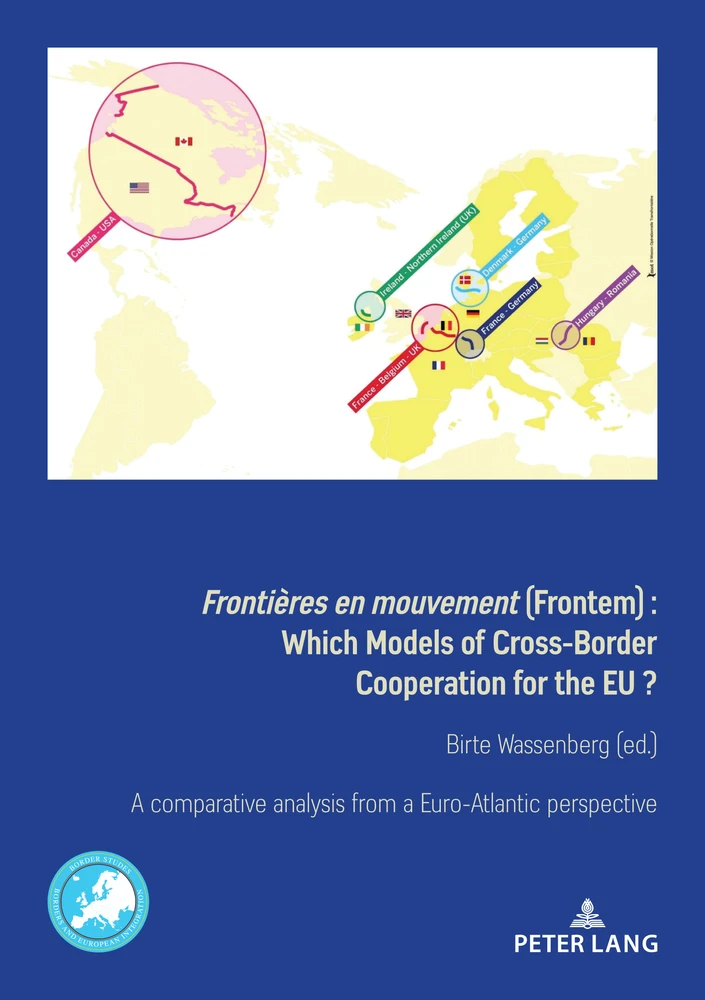
In September 2024 a new book was published that strives to serve as a comprehensive exploration of cross-border cooperation models across various European regions through analysing how borders are perceived and managed in different contexts. The work emerges from the Frontem network, which organised scientific seminars and focus groups in key border regions of Europe, with the goal of better understanding cross-border dynamics, particularly in times of crisis, such as the COVID-19 pandemic. The publication is structured into six parts, each addressing distinct regional examples, while emphasising that no single model applies uniformly across Europe. Each region’s unique context plays a pivotal role in shaping the nature and success of cross-border cooperation.
The first part, on Franco-German cooperation, explores the Greater Region and the Franco-German-Swiss Upper Rhine Region, showcasing their progress in governance and territorial cooperation. Articles in this section, such as those by Reine Wakote and Nora Crossey, emphasise the importance of frameworks like the European Cross-Border Mechanism (ECBM) in empowering local authorities, and how cross-border urban governance evolved during the pandemic. Additionally, the effects of COVID-19 on these regions revealed not only standstills caused by border closures but also revived cross-border dialogue and cooperation, reflecting the resilience and interdependence of these areas.
The second part examines Franco-Belgian cross-border cooperation, which questions the notion of fully open borders within the Schengen Area. While some areas, such as the Eurometropolis Lille-Kortrijk-Tournai, still show visible border effects, examples like the European Natural Park (ENPPSS) demonstrate successful collaboration in areas like water governance. The focus on historical collective memories and heritage, as explored by Fabienne Leloup, highlights the importance of cultural context in fostering cooperation, even when physical borders are not visible.
In the third part, the border between Ireland and Northern Ireland is discussed in light of the Good Friday Agreement and the complications introduced by Brexit. Milena Komavora, Katy Hayward, and Anthony Soares reflect on the changing nature of this border, which has moved from being a hard boundary to a more “invisible” one. However, Brexit has reawakened tensions, making the once invisible border visible again both socially and politically. The contributions also stress the importance of cross-border initiatives in education, such as the SCoTENS project, which fosters collaboration in teacher education despite political uncertainties.
The fourth section on Danish-German cooperation delves into the region’s model of minority management, particularly focusing on the Danish-German-Frisian region. Contributions from authors like Martin Klatt suggest that, while the current status quo of minority cooperation is a best-practice example, there are still challenges, particularly for less visible minorities like the Sinti and Roma. Additionally, during the COVID-19 pandemic, border restrictions revealed tensions around the meaning of mobility and resilience, as discussed by Dorte J. Andersen and Ingo Winklershow, indicating that resilience in border regions is often multifaceted and context-dependent.
In the fifth part, the Hungarian-Romanian border is analysed, with a focus on its evolution from a hard border during the Socialist era to a more cooperative and integrated space in modern times. János Sallai provides historical context, while contribution from Nicolae Păun and Enya-Andrea Tămaș highlights the ongoing transformation of this border region into a model of cross-border cooperation. Melinda Benczi, a CESCI colleague and founding member of the UPS-CESCI Research Group of Cross-Border Cooperation, also analyses this border section in her article ‘Outlining the main perception strands on the Hungarian-Romanian border’ in which she argues that while citizens living in this border region are not hostile, the cooperative spirit is sometimes overshadowed by competitiveness. Furthermore, she also suggests that improving permeability, fostering friendly politics, and reshaping historical narratives could enhance cooperation.
The final section offers a Euro-Atlantic comparison, examining how European cross-border cooperation can serve as a model for other parts of the world, particularly in light of crises such as the COVID-19 pandemic. Jean Peyrony reflects on the lessons learned from border management during the pandemic, emphasising the importance of recognising the interdependencies between regions and advocating for multi-level governance. This section also compares the EU’s cross-border resilience with the more securitised approach seen in US-Canada borderlands, as explored by Emmanuel Brunet-Jailly and Tatsiana Shaban, underlining the distinct challenges that arise when borders are viewed through different cultural and political lenses.
Overall, the publication illustrates how European border regions have adapted to changing circumstances, particularly in response to crises, while showcasing the diversity of models and approaches to cross-border cooperation. It reinforces the importance of understanding borders not just as physical barriers, but as spaces of opportunity for deeper cooperation, resilience, and

