The Future of Cross-Border Cooperation – Zsuzsanna Fejes’ Presentation at the Conference of the Hungarian Regional Science Association
Kutatóműhely | 2024. October 22.

Kutatóműhely | 2024. October 22.
Zsuzsanna Fejes, Head of the LUPS-CESCI Research Group on Cross-Border Cooperation, participated in the 22nd annual conference of the Hungarian Regional Science Association titled “20 Years in the European Union: Convergence, Territorial Policy, and Inequalities”, held in Szeged on 17-18 October 2024.
The conference, co-organised with the Faculty of Economics at the University of Szeged, featured three plenary sessions, a roundtable discussion, and 24 thematic sessions.
The Thursday morning plenary session was conducted in English, with presentations by three distinguished speakers: Simona Iammarino from the University of Cagliari, Jiri Blazek from Charles University in Prague, and Valentina Ivanić from the Institute of Economics in Belgrade. The plenary talks explored the future of EU regions and territorial policies, as well as the possibilities for regional governance, with a focus on the prospects and opportunities for territorial convergence in Serbia and the Balkans.
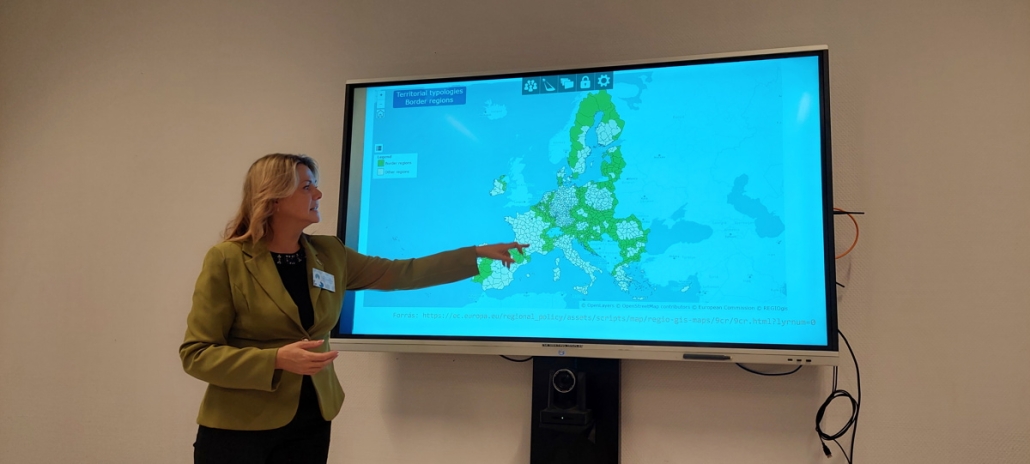
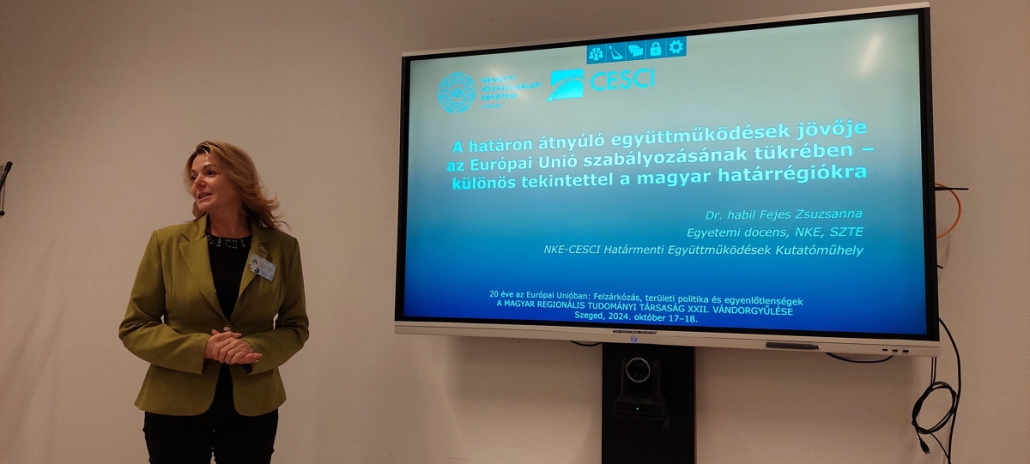
On the afternoon of 17 October, Zsuzsanna Fejes gave a presentation in the thematic session titled “State Borders, Integration, and Territorial Policies”, under the title “The Future of Cross-Border Cooperation in Light of EU Regulations – with Special Regard to Hungarian Border Regions”. Her presentation focused on the legal framework of cross-border cooperation. The aim was to examine and showcase the possibilities, solutions, and best practices for removing legal barriers to cross-border territorial cooperation and the processes of cross-border institution-building in the European Union, with special attention to Hungary. She highlighted that in 2021, the European Commission published a report titled “EU Border Regions: Living Laboratories of European Integration”, which demonstrated the positive effects of addressing cross-border obstacles on both the border regions and the EU as a whole, drawing on lessons learned from the Covid-19 pandemic.
Last year, the European Parliament revisited this initiative, and on 12 December 2023, the European Commission published a legislative proposal aimed at providing a simpler, primarily voluntary solution for removing legal obstacles, establishing a permanent framework. The Commission’s goal is to adopt regulatory minimum conditions that allow for the short-term resolution of emerging obstacles and the initiation of a European network.
The session fostered a meaningful professional discussion among the participants, with particular attention to the future of the EU’s territorial cohesion and cross-border cooperation. They debated how these can be reconciled with the changing European discourse, where instead of cooperation and the removal of borders, security concerns have come to the forefront, leading to the re-closing of borders, the construction of new borders, and the implementation of stricter border controls.
Outdoor photos: MRTT website, indoor photos are owned by the lecturer.

 Report on the Research Groups’ Conference: Rethinking Cross-Border Cooperation...